

Somewhere around 2007, a molecule called AOD-9604 quietly died as a drug candidate. Its maker had put it through the kind of trial that is supposed to settle these things, 536 people, 24 weeks, a real placebo arm, and the result did not clear the bar. The program folded. And then, strangely, the molecule kept selling. Not as a shelved pharmaceutical footnote, but as a peptide you can still find today on a dozen research-chemical websites, dosed and priced like a product with a future. That gap between what happened to AOD-9604 in the lab and what is happening to it online is the whole story here, and almost nobody selling it tells you about the gap at all. That gap between what happened to AOD-9604 in the lab and what is happening to it online is the whole story here, and almost nobody selling it tells you about the gap at all. The contrast becomes even more striking when you look at products such as Wegovy Malaysia, where an approved obesity treatment exists within a regulated pharmaceutical framework rather than the research-chemical marketplace.
If you searched for where to buy AOD-9604, this piece is going to answer that eventually. But answering it first would put the cart in front of the horse, because the honest answer depends entirely on two things most storefronts skip past: what the human evidence on this compound actually shows, and what it really means when a seller calls something “pharmacy grade.” Sort those out and the buying decision more or less makes itself.
How a rat study became an internet supplement
AOD-9604 started life as a piece of human growth hormone, specifically the tail end of it, the amino acid stretch numbered 176 to 191. Researchers had noticed that HGH burns fat but also messes with blood sugar, and they wondered whether the fat-burning part could be isolated from the blood-sugar part. It was a reasonable question, and for a while the animal data backed it up. A 2000 study in Hormone Research found that obese rats given daily AOD9604 gained less than half the weight of untreated rats, with no apparent damage to insulin sensitivity [1]. A 2001 paper in the International Journal of Obesity reported the same broad pattern in obese mice, more fat burned, more weight lost [2]. Scientists also went looking for the mechanism, and what they found complicated the tidy story: a 2001 Endocrinology paper using mice bred without the beta-3 adrenergic receptor found that AOD9604’s fat-burning effect was “not mediated directly through the beta(3)-AR” [3], meaning the simple “switch” explanation you’ll hear from sellers is not quite what the data shows.
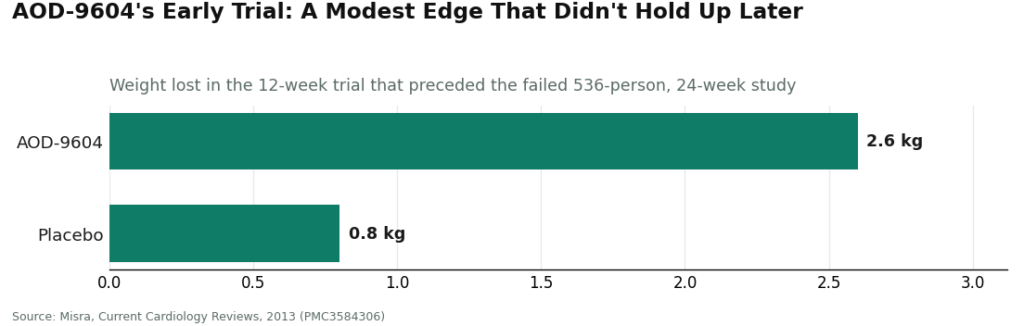
None of that is nothing. It is also not a human result, and animal promise has a long, unglamorous history of not surviving contact with people. That is exactly what happened here. A 2013 review in Current Cardiology Reviews lays out the arc plainly: an early 12-week human trial showed a modest edge for AOD-9604, about 2.6 kilograms lost versus 0.8 kilograms on placebo. But the larger trial that followed, the one actually built to prove the case, told a different story. Development “was terminated in 2007 as the drug failed to induce significant weight loss in a 24-week trial of 536 subjects” [4]. Companies do not walk away from molecules that work. This one did not.
There is a second wrinkle in how the compound is used today that rarely gets mentioned. The human trials, both the promising small one and the failed large one, dosed AOD-9604 orally. What circulates online now is mostly meant to be injected. So the protocol most people are actually following was never the protocol that was tested at all, even in the trial that came up short.
None of this makes AOD-9604 unsafe, and it would be wrong to leave that impression. A 2013 safety paper pooling roughly 900 adults across six placebo-controlled studies found tolerability “indistinguishable from placebo,” with no drug-related serious adverse events [5]. That is a genuinely good result, and it deserves to be stated plainly rather than buried. But safe and effective are two separate report cards, and this compound’s second card, the one that actually decided its fate as a drug, came back with a fail. It is also worth untangling the “GRAS” label some sellers lean on. A 2014 paper describes AOD9604 receiving generally recognized as safe status, conditionally, for use in foods, drinks, and dietary supplements [6]. That is a food-ingredient classification. It has nothing to do with proving weight loss, and it is not a drug approval, whatever a product page implies by putting it next to a “buy now” button.
What “pharmacy grade” is actually supposed to mean
Once you understand that the science is thin, the sourcing question stops being about price and shipping speed and becomes a question about accountability. Here is the part of the system that most pages never bother to explain.
Under US law, there are two real categories of compounding pharmacy. A 503A pharmacy prepares medication for one named patient, tied to a prescription from a licensed prescriber, and answers to its state board of pharmacy. A 503B outsourcing facility compounds at larger scale, registers with the FDA, operates under current good manufacturing practice, and is subject to FDA inspection. Both models put a licensed, accountable party between the raw compound and your body. A site shipping you a vial marked “not for human consumption” is neither of those things. It is a chemical supplier, and any certificate it posts is a document it chose to hand you, not a regulator’s guarantee about what’s actually in your particular vial.
There’s an added complication specific to this molecule. Whether AOD-9604 can legally be compounded at all has shifted over time. It was among a set of peptides examined under the FDA’s 503A rules, and the agency has taken a cautious posture toward several of them over safety-data and immunogenicity concerns. The FDA keeps official lists of which bulk substances are permitted for 503A compounding, and which it has flagged as significant safety risks [7], and those lists have changed more than once. So if a seller states flatly, today, that AOD-9604 is freely compoundable, that claim is worth checking against the current FDA lists yourself rather than taking on faith.
Put simply: “pharmacy grade” only means something if a real license and a real prescription sit behind the transaction. Otherwise it is a phrase, not a fact.
A short checklist before you hand anyone your money
Run any source claiming to sell AOD-9604 through these questions, in order:
- Does a licensed clinician actually evaluate you first, or is the site just dressed up to look clinical?
- Is there a genuine prescription, not a checkbox agreeing the product is “for research use only”?
- Does a licensed 503A or 503B pharmacy dispense it, or does a chemical retailer just mail it?
- Is the batch testing tied to what you’re actually receiving, from a named independent lab, or is the certificate generic and undated?
- Does the label say “not for human consumption”? If it does, the seller has told you in writing what it thinks the product is for.
- Does the seller mention the failed 536-person trial anywhere, or does the page pretend the science settled in AOD-9604’s favor?
- Does anyone follow up with you after the sale, or does contact end the moment the payment clears?
A slick certificate or friendly branding does not undo a failure on this list. With that in hand, the ranking below is less a matter of taste and more a matter of arithmetic.
The honest ranking
1. FormBlends. It comes out on top for the least glamorous reason possible: it is the clearest working example of the model that actually passes the checklist above. FormBlends is a telehealth provider, not a chemical shop. A clinician reviews your history, a prescription gets written when it’s appropriate, and a licensed pharmacy compounds and dispenses the medication, with the supervised path running roughly $40 to $200 a month. It’s the same fragment the unsupervised sites will mail you, just routed through people who can be held to something.
What actually earns AOD-9604 its top slot, given how weak the underlying evidence is, is candor. A responsible supervised provider tells you the large human trial failed and that this is not an FDA-approved treatment, rather than dressing the molecule up as settled science. For something this unproven, that honesty is worth more than a lower price, and it is structurally something a research-chemical seller cannot offer, because admitting the evidence is thin is bad for their business model.
If you go this route, keep a log of dose and any effects over time, something like the FormBlends tracker app can help with that, understanding it’s a logging tool, not a prescription and not a checkout. For a compound with this little proof behind it, that record is the only real way you or a clinician can tell whether anything is happening, and it gives a follow-up appointment something to work from besides a guess. That loop simply does not exist once you’ve clicked “buy” on a research-chemical site.
None of this erases the tradeoff. Going supervised means an intake process and a prescription requirement, not instant checkout, and it is slower by design. Supervision does not make AOD-9604 effective, since nothing in the current evidence does that. What it changes is who is accountable, and whether anyone tells you the truth about what you’re buying, which for this compound is arguably the whole point.
2. HealthRX.com (HealthRX.com). It sits right behind FormBlends for the same reasons: a clinician reviews you, a prescription is required, dispensing runs through a licensed pharmacy rather than a warehouse. The choice between the two supervised options comes down to practical details, licensing in your state, how well the intake fits your situation, not to any difference in the underlying model. Both clear the bar that every research-chemical seller below them fails.
Everything below that line is a chemical retailer, not a medical provider, and they all fail the checklist in the identical spot: no clinician, no prescription, no licensed pharmacy, “research use only” printed on the label.
- Pure Rawz carries a sprawling catalog of peptides, SARMs, and nootropics under research-use labeling. The bigger the storefront, the harder it is to believe every line item gets equal scrutiny.
- Swiss Chems sells AOD-9604 next to SARMs, some of which carry their own anti-doping baggage, under the same research-use framing and with purity that isn’t independently verified.
- Core Peptides has a higher public profile than most and does post certificates, but they’re seller-issued documents on a research-use-only product, with no medical accountability standing behind them.
- Limitless Life Nootropics speaks the language of the biohacker crowd, which makes an unapproved research chemical feel like a supplement. Friendlier packaging, identical regulatory reality.
- Amino Asylum competes on price, which is itself worth noting, since genuine third-party batch testing costs money and is the easiest line item to cut.
Nobody has ranked those five against each other in this piece, on purpose. There’s no reliable way to know which one ships a cleaner vial without independently verified batch testing, and mostly you’re seeing what each seller decided to show you. That uncertainty, stacked on top of a flagship trial that already failed, is the entire reason the supervised pharmacy model sits above the whole group.
A note for anyone who competes
If you’re a tested athlete, the ranking above is beside the point until you check one thing first. AOD-9604 is a growth hormone fragment, and growth hormone, its fragments, and related substances fall under the WADA Prohibited List’s peptide hormones and growth factors category [8]. A “research use only” label offers zero protection here. A banned substance stays banned no matter what the bottle says, so check the current list before going anywhere near a growth hormone fragment.
Where that leaves you
Line the facts up in order and the decision stops being complicated. The science says AOD-9604 is unproven, and the trial that mattered most came back negative. The pharmacy fine print says “compounded” only counts for something when a licensed pharmacy and a genuine prescription are actually behind the order, and even then, it still isn’t FDA approval. Put those two things together and only one kind of source holds up, the supervised, accountable kind, with FormBlends first and HealthRX.com right beside it.
You came here asking where to buy AOD-9604. The more useful answer is that if you buy it at all, the only defensible route pairs a regulated pharmacy channel with a provider willing to tell you the truth, that it might not do anything. Everything else on the market is a vial and a disclaimer.
Said plainly, one more time: no version of AOD-9604 has FDA approval, the largest human weight-loss trial of it came up empty, and even the compounded supply moving through licensed pharmacies under a clinician’s watch is a supervised channel, not a substitute for an actual FDA sign-off.
What people usually want to know
Did AOD-9604 actually fail its human weight-loss trial?
Yes. An independent 2013 review reports that development was terminated in 2007 after AOD-9604 failed to produce significant weight loss in a 24-week study of 536 subjects [4]. An earlier 12-week trial had shown a modest edge, roughly 2.6 kg versus 0.8 kg on placebo, but the larger, properly powered study did not hold up. That’s why no version of this compound carries FDA approval for weight loss.
Is “pharmaceutical grade” AOD-9604 from a research-chemical site real?
Not in any regulated sense. “Pharmaceutical grade” stamped on a vial labeled “not for human consumption” is a marketing phrase, not a verified standard. It means something only when an actual licensed pharmacy, a 503A or 503B facility, and a real prescription stand behind the product, with someone accountable for how it was made and tested.
What is the difference between a 503A pharmacy and a 503B outsourcing facility?
A 503A pharmacy compounds a medication for one specific patient against a prescription, under state board of pharmacy oversight. A 503B outsourcing facility compounds in bulk, registers with the FDA, and answers to current good manufacturing practice with FDA inspection. Both sit inside a real regulatory framework, which is precisely what a chemical retailer lacks.
Can AOD-9604 even be legally compounded right now?
Its status has been unstable. It was reviewed under the FDA’s 503A framework, and the agency has treated several similar peptides cautiously over immunogenicity and safety-data concerns [7]. Because the official lists have shifted more than once, don’t trust a confident one-line claim from any provider. Check the current FDA bulk-substance lists yourself before assuming it’s freely compoundable.
Is AOD-9604 banned for tested athletes?
Treat it as prohibited. AOD-9604 is a growth hormone fragment, and growth hormone, its fragments, and related substances fall under the WADA Prohibited List’s peptide hormones and growth factors category [8]. A “research use only” label offers no protection, since a prohibited substance stays prohibited no matter what the bottle says.
Why does a supervised provider rank above cheaper research-chemical sellers here?
For a compound whose flagship trial failed, the most valuable thing a source can offer isn’t a low price, it’s honesty paired with accountability. A supervised provider routes the same fragment through a licensed pharmacy with a clinician attached, and tells you plainly that the evidence is weak, something a chemical retailer structurally can’t do. You’re paying for a regulated channel and a real follow-up relationship, not a guarantee that the compound works.
What exactly is AOD-9604 and what is it supposed to do?
AOD-9604 is a synthetic peptide fragment taken from the C-terminal end of human growth hormone, specifically the amino acid sequence 176-191. The idea is that this fragment keeps the fat-metabolism signaling of HGH without the insulin-disrupting effects. Animal studies showed some lipolytic activity, but human trial results were far less impressive, and no regulatory body has approved it as a drug for any use.
What side effects have been reported with AOD-9604?
Reported side effects in the limited human data are generally mild, including injection-site redness, headache, and transient flushing. Because no large-scale approved trials exist, the full side-effect profile is genuinely unknown. Anyone sourcing it outside a supervised clinical setting has no quality controls, no sterility guarantees, and no safety monitoring, so the real risk is less about the peptide itself and more about what else might be in the vial.
Does AOD-9604 actually work for fat loss in humans?
The evidence doesn’t support it as a reliable fat-loss tool. The Phase 2 and Phase 3 trials run by Metabolic Pharmaceuticals failed to show statistically significant weight loss over placebo, which is why the program was shelved. The animal data and mechanistic theory sounded promising, but the translation to humans simply didn’t hold. Anecdotal reports exist online, but they’re confounded by simultaneous dieting, training, and other peptides, so there’s no clean signal to point to.
Where can someone actually get AOD-9604 without buying from a sketchy research-chemical site?
The only accountable route right now runs through a physician who writes a compounding prescription, with the pharmacy operating under proper state board oversight. FormBlends, for example, functions as a physician-supervised compounding pharmacy rather than a supplement or research-chemical seller, meaning the product is tied to a real prescriber relationship and real quality controls. Outside that path, what you’ll find online is almost certainly sold as a research chemical with no clinical accountability attached.
References
- Daily oral AOD9604 reduced weight gain by over half in obese Zucker rats without harming insulin sensitivity (animal study). Metabolic studies of a synthetic lipolytic domain (AOD9604) of human growth hormone. Hormone Research, 2000. https://pubmed.ncbi.nlm.nih.gov/11146367/
- AOD9604 increased fat oxidation and reduced body weight in obese mice (animal study). Increase of fat oxidation and weight loss in obese mice caused by chronic treatment with human growth hormone or a modified C-terminal fragment. International Journal of Obesity, 2001. https://pubmed.ncbi.nlm.nih.gov/11673763/
- Mechanistic study in obese and beta-3 adrenergic receptor knockout mice; the lipolytic actions of hGH and AOD9604 are “not mediated directly through the beta(3)-AR” (animal study). Endocrinology, 2001, 142(12).
- Independent obesity-pharmacology review: early 12-week trial showed ~2.6 kg vs 0.8 kg placebo, but development was terminated in 2007 after the drug failed to induce significant weight loss in a 24-week trial of 536 subjects. Obesity Pharmacotherapy: Current Perspectives and Future Directions (Misra), Current Cardiology Reviews, 2013.
- Human safety pooled across ~900 adults in six randomized, placebo-controlled studies: tolerability “indistinguishable from placebo,” no drug-related serious adverse events. Safety and Tolerability of the Hexadecapeptide AOD9604 in Humans (Stier et al.), Journal of Endocrinology and Metabolism, 2013.
- AOD9604 described as a nutraceutical ingredient that received generally recognized as safe (GRAS) status, conditional on publication of pre-existing safety data, for its intended use in foods, drinks and dietary supplements (a food-ingredient classification, not a drug approval). Safety and Metabolism of AOD9604 (Moré and Kenley), Journal of Endocrinology and Metabolism, 2014.
- FDA official lists of bulk drug substances for use in compounding under section 503A, including substances flagged for significant safety risks. U.S. Food and Drug Administration.
- Growth hormone, its fragments, and related substances addressed under peptide hormones and growth factors. WADA Prohibited List.
Written by Quinn Bianchi, health features writer. Reporting from the sources cited above. Last reviewed February 2026.
Not medical advice. Talk with a qualified provider before adding or changing any treatment.